Count every home that has been planned or proposed around Potrero Hill and you get well over 6,000. Most of them are already in approved plans. Far fewer have a lender or a public agency paying to build them, and that short list is what will change the hill's edges between now and 2030.
Around the hill, a project's opening date follows its money. Each one below is grouped by how much of that money is in place.
The Power Station's approval came in 2020; its money came building by building
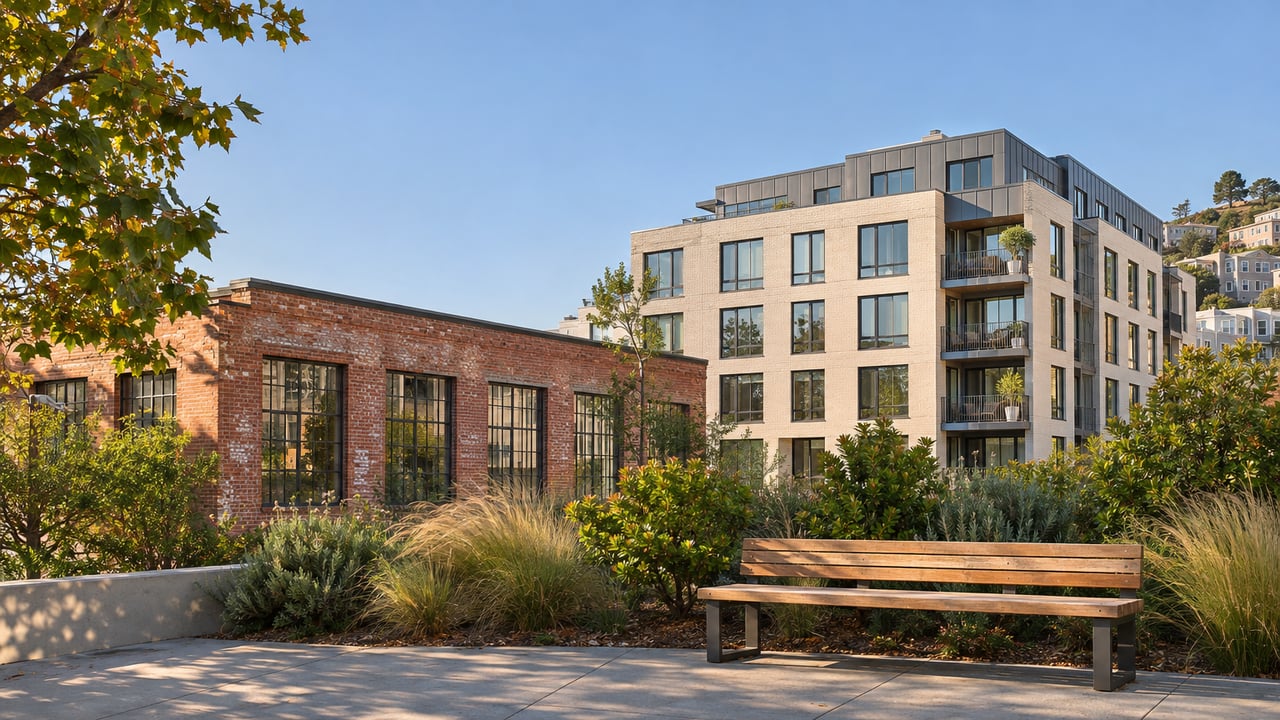
The Potrero Power Station site on the Dogpatch waterfront has the biggest plan near the hill. The city-approved buildout is about 2,601 homes, 6.9 acres of open space, 100,000 square feet of retail and a 250-room hotel, and SF Planning describes a schedule that could run as long as 30 years.
The site has been building at the pace its financing allows. Its first building, the 105-unit Sophie Maxwell Building at 1212 Maryland Street, opened in October 2025 as housing for middle-income households, the San Francisco Standard reported. Around the same time, the Potrero View reported that Phase 1 infrastructure was being finished, including the seawall, street trees, sidewalks and utility work.
The next building got its financing in August 2026. The Standard reported that JPMorgan Chase committed nearly $200 million to a 342-unit apartment building at the site. That was the bank's second investment in the project, after it helped finance Sophie Maxwell. The developer, now called Fifth Space and formerly Associate Capital, is working toward about 2,600 homes and 1.6 million square feet of commercial space.
The commercial side has an institutional tenant. Foundation work for the UCSF facility on the site was underway in February 2026, and SF YIMBY's construction report gave 2030 as the expected completion. The developer's own project page lists a 2029 opening. The same page describes Prequel Park, a 2.5-acre public waterfront park around the historic stack. When the developer proposed it, the Chronicle reported that it was planned as an interim space that could last about five years while the hotel parcel waits for better market conditions.
Across six years, the site's approval stayed fixed, and buildings rose one at a time as each found a lender. A buyer can expect the Power Station to keep going the same way: one financed building after another.
Potrero Yard has a public payer and a printed end date
The Muni bus yard at 17th Street is the nearest construction project to the north slope, and it has the clearest schedule of anything on this list. The yard is the block bounded by Mariposa, Bryant, 17th and Hampshire streets. The Board of Supervisors gave final approval on March 24, 2026, and SFMTA's project page expects construction to continue through 2030, with the new yard starting operations that year.
The finished building is a four-story bus storage and maintenance yard that SFMTA says will hold 68% more buses and support its electric trolley-bus fleet. When SFMTA announced the approval in March, it said the yard would be vacated, the site checked and the overhead lines removed later in 2026, with demolition expected in early 2027.
The housing part got smaller once the costs were counted. In a fall 2025 update, SFMTA proposed removing the podium that would have put homes above the bus yard, while keeping the possibility of up to 100 affordable homes along Bryant Street. The bus yard has a public agency paying for it, and it is moving ahead. The homes above it needed extra money, and they were the part proposed for cutting.
For anyone looking at houses on the north side of the hill, the practical takeaway is to expect construction at the 17th and Bryant block for most of the rest of this decade.
The transit upgrades are funded in pieces, with targets in 2027 and 2029
The San Francisco County Transportation Authority has approved design funding for two ramps from street level to the platforms at the 22nd Street Caltrain station, along with tactile strips, lighting, signs and platform improvements. As of April 2026, Caltrain expected to finish design by summer 2027 and was seeking construction funding to build the ramps by June 2029. By September 2026, Caltrain had also won a $14 million federal accessibility grant that covers ramp improvements at 22nd Street, according to the SFCTA board packet.
The same SFCTA report covers a Mission Bay ferry landing next to 16th Street, where the board approved $4.5 million toward a $77.1 million project. The underwater preparation work is done, and the landing is expected to be finished by the end of 2027. Regular passenger service depends on separate funding for San Francisco Bay Ferry.
Pier 70 has a revised plan and a hoped-for 2027 start
Pier 70, the 28-acre Brookfield Properties site in Dogpatch, already has a public space you can visit. Building 12 has 14 tenants, including food, drink, arts and recreation businesses. Bay Padel was pouring concrete for seven more outdoor pickleball courts and four padel courts, next to three indoor courts already open, the San Francisco Chronicle reported in July 2026.
New housing construction on the site was stalled as of that report. Brookfield's plan to restart it is more homes. In July, it outlined a proposal to the Port Commission that would raise the site's maximum from 2,150 homes to 2,750, about 28% more, by adding two stories to several residential buildings. The Chronicle described this as part of a citywide pattern of developers adding density to make the numbers work after market-rate housing production stalled during the pandemic.
Brookfield told the Chronicle the revised plan could allow a 2027 start on a 350-unit first housing building at the site's Lot E2, part of a 700-home first phase, and it hopes to start a 300,000-square-foot office building in 2027 if the office market keeps recovering. Those are construction start dates Brookfield is hoping for, not opening dates.
Rebuild Potrero is on the hill itself, and the work so far is demolition
The largest project on the hill itself is on the south slope. The approved Potrero HOPE SF plan, known locally as Rebuild Potrero, calls for about 1,700 homes. That includes 619 replacement affordable homes, about 200 more affordable homes and about 800 market-rate homes, plus 3.5 acres of open space and about 45,000 square feet of neighborhood retail and community space, according to SF Planning. Phase 1 at 1101 Connecticut was finished in 2019.
In June 2026, the Potrero View reported that demolition of 23 Potrero Annex buildings was underway and could continue into February 2027. A month later, Mission Local's photo essay showed Annex buildings reduced to their concrete foundations. The new streets, parks and storefronts in the plan come in later phases.
What's already open below the hill
Some of the waterfront is already built and open, and it's the part you'll use first. Crane Cove Park has been open since about 2020. Esprit Park reopened in February 2025 after a complete renovation, and Rec and Park's May 2026 update covered routine maintenance and a planned boardwalk repair. Building 12 at Pier 70 is open, and so is the Sophie Maxwell Building.
The bus lines run today. SFMTA lists weekday midday service on the 22 Fillmore every six minutes along the 16th Street corridor toward Mission Bay and UCSF. The 55 Dogpatch runs daily from 5 a.m. to 10 p.m. every 20 minutes and connects Dogpatch and Potrero stops to 16th Street Mission BART.
What changes before 2030, and what probably doesn't
Line the projects up by funding and you get a calendar. In 2027, demolition is expected at Potrero Yard, the Annex demolition is due to wrap up, the ferry landing is targeted for completion and Pier 70 may break ground. In 2029, the 22nd Street ramps are targeted and UCSF's opening is listed. In 2030, the new bus yard starts operating. The firmest of those dates belong to projects with a public agency, an institution or a named lender behind them.
Most of the thousands of homes in the long-range plans are approved but still waiting for a lender, building by building. For a buyer, that means the Potrero Hill you'd buy into this winter is close to the one you'd live in through the end of the decade. Construction will continue at the base of the hill, the first finished pieces will show up along the water, and the 22 and 55 will keep running in the meantime. On the hill itself, the views and streets you see today are what you're buying. You'll get more for your money comparing the hill's own blocks, and how different the ground is from hilltop to flats, than betting on how fast the waterfront fills in.
If you're weighing a house a few blocks from Potrero Yard against one closer to 22nd Street, tell me which blocks you're looking at and we can talk through which of these projects sits closest to each. Start on my Potrero Hill neighborhood page, or reach out to Stephanie LeBeau directly.